Imperative of Uncertainty in Autonomous Computer Vision Systems
By bataSutra Editorial • October 3, 2026
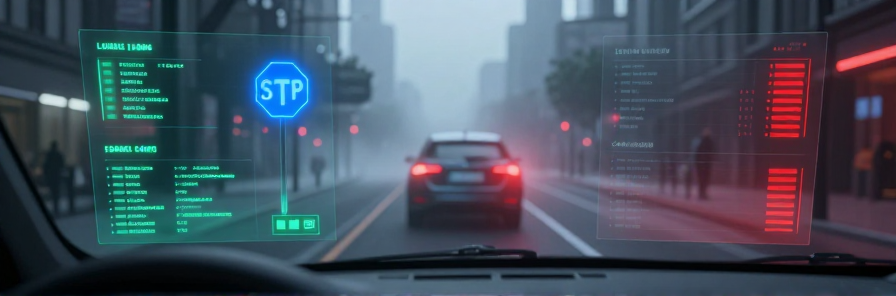
Deployment of autonomous systems—ranging from Level 4 self-driving vehicles to industrial surveillance drones—represents one of the most significant shifts in transportation and logistics history. However, with this technological leap comes an unprecedented liability landscape. Unlike traditional automotive controls, where failures are often mechanical or deterministic, computer vision systems operate in probabilistic environments subject to environmental variability. A standard Deep Learning (DL) model functions as a "black box" optimizer; it provides a single prediction for a given input, typically accompanied by a confidence score derived from the softmax probability of the highest class.
The industry's current reliance on these point-estimate models presents a critical safety vulnerability. These models frequently exhibit over-confidence on inputs they have never encountered during training. When a model misclassifies an object with absolute certainty, or fails to detect a pedestrian in fog, the resulting risk is catastrophic. To mitigate these risks, the field must shift from merely maximizing accuracy to quantifying uncertainty. Uncertainty Quantification (UQ) is not a luxury feature; it is a fundamental requirement for functional safety in high-stakes environments. This article analyzes the theoretical foundations and practical implementations of UQ within autonomous systems, distinguishing between irreducible noise and model ignorance, and outlines the safety protocols required to integrate these metrics into operational decision-making logic.
Anatomy of Uncertainty in Perception Systems
To design safe autonomous systems, engineers must first categorize the sources of error. In Bayesian terms, uncertainty is generally divided into two distinct classes: aleatoric and epistemic. Understanding the difference between these two forms of risk dictates how an algorithm responds to a specific threat.
Aleatoric Uncertainty refers to the inherent randomness or noise in the data itself. This uncertainty is irreducible; even with perfect training data and infinite computational power, this error cannot be eliminated. In the context of computer vision for autonomous vehicles (AVs), aleatoric uncertainty stems from sensor limitations and environmental conditions. Examples include heavy rain obscuring a pedestrian’s outline, glare from oncoming headlights saturating the camera sensor, or low-texture backgrounds where lane markings vanish.
From an engineering perspective, aleatoric uncertainty is often correlated with distance or sensor confidence. When a vehicle approaches an object at 20 meters in daylight, the pixel density is high, and noise is low. When that same vehicle attempts to identify a cyclist under heavy fog, the image quality degrades, increasing the aleatoric uncertainty of the classification task. A Bayesian model captures this by increasing the variance of its output distribution. The system knows it is struggling because the input is poor. Safety protocols for aleatoric uncertainty focus on hardware robustness (e.g., thermal cameras that penetrate fog) or sensor fusion (using LiDAR to triangulate position when visual certainty drops).
Epistemic Uncertainty, by contrast, relates to the model's lack of knowledge due to insufficient training data. This form of uncertainty is reducible; it can be mitigated by exposing the system to more diverse and comprehensive training scenarios. Epistemic uncertainty manifests when the model encounters an object or scenario outside its "world distribution".
Consider a self-driving vehicle navigating a city in North America that suddenly enters a region populated entirely by right-hand traffic but encounters a bus stop with signage written in a dialect it has not seen, or perhaps more critically, encountering a delivery drone it has never learned to classify. The model does not just guess; it effectively says, "I do not know what this is." In standard Deep Learning, such scenarios often result in the model defaulting to the highest probable class (e.g., labeling a strange object as a "trash can"). However, in Bayesian Deep Learning, epistemic uncertainty manifests as high variance across predictions. The system recognizes its ignorance.
The distinction is vital for deployment. If a drone encounters a new bird species in an open field, that is a model gap (Epistemic). If the drone encounters heavy wind turbulence shaking its camera lens, causing motion blur, that is environmental noise (Aleatoric). The remediation strategies differ fundamentally. You do not fix epistemic uncertainty with better cleaning; you fix it with data augmentation or active learning to acquire new scenarios. You do not fix aleatoric uncertainty with more data of the same environment; you fix it with sensor hardware upgrades.
Bayesian Deep Learning Techniques for Risk Measurement
Standard convolutional neural networks (CNNs) optimize for a single loss value (usually Cross-Entropy), converging on a set of weights that minimize error on the training set. They lack an explicit representation of probability distributions over these weights. To quantify uncertainty, engineers utilize Bayesian Deep Learning techniques that model weights as random variables rather than fixed values.
One of the most pragmatic techniques for real-world deployment is Monte Carlo Dropout (MC-Dropout). In traditional use, dropout layers are active only during training to prevent overfitting; at inference time, they are disabled to maintain speed and accuracy. However, keeping dropout active during inference forces multiple neurons to participate in different subsets of computations. When this process is repeated multiple times for the same input image, the resulting variations in output predictions provide a statistical measure of variance. High variance indicates high uncertainty. This is computationally efficient compared to training multiple independent models, yet it offers ensemble-level robustness without the storage penalty of keeping ten separate model instances on a vehicle's edge computing hardware.
Another method involves Variational Inference (VI) and methods based on Conjugate Priors. Here, the neural network is treated as part of a generative probabilistic framework. During inference, instead of outputting a single bounding box, the system outputs a probability distribution over potential locations and classes. For object detection tasks, this might result in a prediction distribution where the model generates 100 potential boxes for an occluded pedestrian. The intersection-over-union (IoU) of these potential boxes provides a measure of confidence that is more honest than the raw softmax output of a deterministic network.
Deep Ensembles represent another layer of safety logic, though they are computationally expensive. This approach involves training multiple models with different initializations or architectures on the same data. When an autonomous system detects a stop sign in rain (aleatoric uncertainty), one model might detect it clearly while another is confused. The agreement between these models helps distinguish between "I know this is a stop sign" and "The input is noisy." However, Ensembles primarily capture epistemic uncertainty effectively, as different random weight initializations explore the loss landscape differently.
To integrate these techniques into safety-critical systems, engineers must optimize for latency. Calculating uncertainty cannot add more than 50ms to inference time if it does not trigger a hazard condition. This necessitates lightweight implementations of Bayesian networks or the use of hardware accelerators designed to handle probabilistic inference on edge devices (like NVIDIA DRIVE Orin or Qualcomm Snapdragon Ride platforms).
Operational Safety Protocols and Decision Logic
The technical output of uncertainty metrics is useless without a decision-making protocol that acts upon them. In aviation, "uncertainty leads to caution." In autonomous driving, this translates into specific operational states: Disengagement, Slow-Down, and Handover.
Thresholding and Risk-Averse Classification Every prediction pipeline must define a minimum confidence threshold. If an object detection model returns a confidence score below 95%, the system should treat that object as unverified. In an AV, this means ignoring the object for automated braking decisions or requesting human intervention. For example, if a vehicle approaches a lane change request but the UQ metrics indicate high epistemic uncertainty regarding the presence of a cyclist in the blind spot, the system must default to a "safe state"—maintaining lane and speed rather than swerving toward the uncertainty.
Sensor Fusion Based on Confidence Metrics Autonomous systems are rarely reliant on vision alone. They utilize Sensor Fusion to cross-reference LiDAR, Radar, and Camera data. A robust UQ protocol dictates that sensors with lower uncertainty take precedence. If the camera exhibits high aleatoric uncertainty due to fog (sensor noise), but the LiDAR radar confirms an object exists at a specific distance with low variance in its return signal, the system proceeds based on the LiDAR data. However, if all sensors exhibit high epistemic or aleatoric uncertainty (e.g., a construction zone with poor visibility for cameras and noisy radar returns), the "total uncertainty" spikes. At this point, the autonomy stack must disengage control entirely and hand back operational authority to a human driver, if available, or bring the vehicle to a safe stop at a designated layover area.
Active Learning Loops Epistemic uncertainty offers a strategic advantage for fleet management systems. When a self-driving car encounters an event it is uncertain about (e.g., a specific animal species on a rural highway), it logs this as a high-uncertainty "edge case." The vehicle does not need to stop the service; rather, it uploads the raw video data to a central server. This initiates an Active Learning loop where engineers retrain the model with these specific edge cases. In the next OTA (Over-the-Air) update, the system becomes more confident in that specific scenario. This transforms uncertainty from a static liability into a dynamic feedback mechanism for safety improvement.
Safety Protocols for Drones and Low-Altitude Flight
Stakes are particularly high for autonomous drones used in infrastructure inspection or delivery. Drones often fly at lower altitudes and through complex urban canyons where GPS signals are lost (urban canyon effect). In these environments, UQ is critical for navigation autonomy. If a drone's visual odometry system detects high uncertainty due to textureless walls (aleatoric), it must switch to barometric pressure or magnetometer-based navigation protocols immediately.
Furthermore, consider the safety protocols required if a delivery drone encounters heavy precipitation. Standard DL models trained on sunny datasets will likely assign high confidence to objects that do not exist in rain data. A Bayesian framework allows the system to recognize "It's raining, I've seen this environment before but not this amount." The protocol response might be to reduce payload speed and increase vertical lift reserve, or abort the delivery. In a collision-avoidance scenario, if UQ indicates high risk of an undetected obstacle (high epistemic variance), the flight controller should execute "divert," even if it results in mission failure, rather than attempt a risky landing maneuver.
Regulatory and Liability Implications
The inclusion of UQ metrics is not merely technical; it has profound legal implications. Current safety regulations, such as ISO 26262 for automotive functional safety, classify "Safety Goals" that rely on probabilistic risk assessment. As SAE Levels 3 and 4 move toward commercialization, regulators will demand evidence that the vehicle can recognize its own limitations.
Liability attribution becomes clearer with UQ. If a pedestrian is hit because the model was over-confident (misclassification of a black cat as a shadow) in high light conditions, the system's failure to quantify aleatoric uncertainty proves negligence. However, if a system encounters a swan and fails to identify it correctly, but its log data shows high epistemic uncertainty triggering a brake event that delayed braking by 0.5 seconds, liability is mitigated. The UQ log becomes the "black box" for insurance and legal proceedings, distinguishing between "human-machine interface error" and "system ignorance."
For drone manufacturers, certification bodies (such as the FAA or EASA) will increasingly require uncertainty logs in safety cases for approval. A system that asserts "I see nothing" when a bird is present due to motion blur is safe. A system that asserts "I see a clear sky" while ignoring birds due to training data bias is unsafe.
The Trade-Off Between Performance and Safety
A common critique of UQ is the performance penalty. Implementing Bayesian networks or MC-Dropout often results in slightly lower top-line accuracy compared to state-of-the-art deterministic models on clean validation sets. A deterministic model might classify a stop sign with 99% confidence; a Bayesian model might say 85% confidence and ask for sensor corroboration.
Is the loss of raw accuracy worth the gain in safety? In high-stakes scenarios, yes. An autonomous system that refuses to drive when visibility is below a threshold is safer than one that drives blindly. However, this trade-off requires careful calibration. Engineers must define "uncertainty margins" that do not trigger false disengagements unnecessarily. If an AV disables itself every time it sees a construction zone because the model hasn't seen every type of traffic cone, the utility drops to zero. The solution lies in hierarchical uncertainty management.
Layer 1 (Aleatoric): Filter out sensor noise thresholds (e.g., "If IR sensor noise > X, alert but proceed"). Layer 2 (Epistemic): Require human takeover if model variance exceeds the defined bound for new object classes. Layer 3 (Total Uncertainty): Stop the vehicle entirely. This hierarchy ensures that the system does not become paralyzed by minor uncertainties while remaining vigilant regarding catastrophic ones.
Future Directions: Scalable Bayesian Architectures
Scalable Bayesian Architectures As autonomous fleets scale, the computational cost of rigorous Bayesian inference must be addressed. Future architectures will likely employ knowledge distillation—training a large "teacher" Bayesian model to compress its probabilistic weights into a smaller "student" student model that retains uncertainty properties. This allows fleet vehicles with limited compute power (e.g., older AV hardware or small delivery drones) to utilize robust UQ techniques without draining battery capacity.
Furthermore, the integration of physical world knowledge into neural networks remains a frontier. Currently, models learn object features from pixels alone. Introducing physics priors (e.g., knowing a person cannot walk through a wall, or gravity dictates how a falling box lands) can theoretically lower aleatoric uncertainty because the model incorporates rules of reality into its architecture. This hybridization of symbolic AI and Deep Learning is where the next generation of safety protocols will live.
The deployment of autonomous computer vision systems requires a paradigm shift from blind confidence to quantified humility. By distinguishing between aleatoric uncertainty (environmental noise) and epistemic uncertainty (model ignorance), engineers can design systems that know when they are wrong and act accordingly. Bayesian Deep Learning provides the mathematical framework for this capability, but it is the operational protocols—sensor fusion thresholds, disengagement logic, and active learning feedback—that turn these metrics into safety guarantees.
We cannot afford to automate the world with models that claim 100% certainty without a statistical justification for that claim. In an era of high-profile accidents involving autonomous technology, the industry must demonstrate that safety is not sacrificed at the altar of performance metrics. Uncertainty Quantification is the only mechanism capable of bridging the gap between theoretical intelligence and operational safety.
For self-driving cars and drones to achieve Level 5 autonomy or safe Level 4 operation in all environments, they must embrace the uncertainty inherent in the physical world. They cannot predict every scenario, but they must programmatically recognize when an environment exceeds their probability bounds. The protocols must dictate: When uncertainty is high, action must be paused. This "fail-safe" logic powered by Bayesian methods is the non‑t