Ocean Conveyor Belt: Thermal Salinity Shifts in a Warming Atlantic
By bataSutra Editorial • October 8, 2026
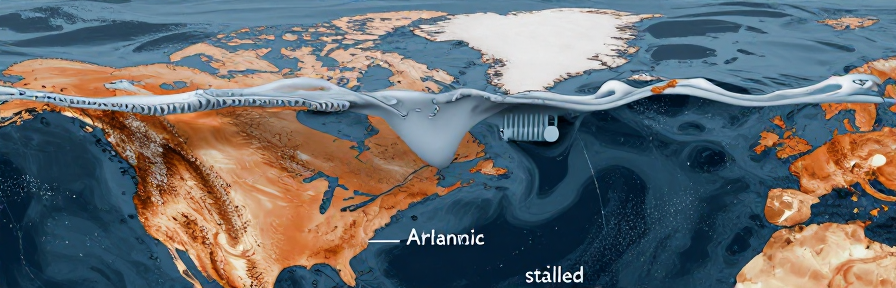
The ocean conveyor belt, scientifically referred to as the Atlantic Meridional Overturning Circulation (AMOC), operates as the planetary thermostat that distributes heat energy from the equator toward the poles. This massive system functions not merely as a current of water but as a thermohaline pump that drives global climate patterns by moving warm surface waters northward and sinking cold, dense waters southward at depth. Currently, the stability of this engine is under unprecedented threat due to the accelerating melting of the Greenland Ice Sheet, which introduces vast quantities of fresh water into the North Atlantic basin. This influx of freshwater creates a stratification effect that directly interferes with the thermohaline mechanism responsible for driving deep‑water formation, fundamentally altering the density gradients that anchor the conveyor belt to its current operational speed. The scientific consensus emerging from climate models suggests that the AMOC has already weakened significantly over the past few decades, and if this freshening continues at current rates, a significant slowdown or shutdown of the system could trigger abrupt and non‑linear climate shifts. These shifts would disproportionately impact high‑latitude economies and global food security networks far beyond the immediate Arctic region, challenging the fundamental assumption that warming will be uniform across the globe. The mechanics behind this potential collapse are rooted in basic fluid dynamics where saltier water sinks more readily than freshwater due to its higher density, and the massive meltwater inputs from Greenland are effectively acting as a lid on the ocean surface that prevents the necessary deep‑water formation required to sustain the circulation loop. Understanding the physics of this system is not an academic exercise but a matter of survival for coastal civilizations dependent on predictable seasonal weather patterns.
Physics of Density and Freshening: How Ice Melt Chokes the Pump
Core mechanism driving the Atlantic Meridional Overturning Circulation relies heavily on the relationship between salinity and density, a concept known as halocline stratification which is critical for understanding why the system might stall under current climate stress. In a healthy, active state, warm salty water flows northward from the Gulf Stream, cools rapidly over the Greenland Sea and Labrador Sea, and sinks because its high salinity makes it denser than the surrounding polar waters. This sinking process pulls surface waters downward, creating a vacuum effect that draws more warm water northward to replace what has sunk, perpetuating the cycle that distributes heat globally. However, when ice sheets melt, they release low‑salinity fresh water into this dense water mass, lowering the overall density of the surface ocean in the North Atlantic. This fresher layer sits atop the denser saltier water below, creating a stable stratification that prevents vertical mixing and sinking.
If the concentration of freshwater becomes high enough, the water simply cannot sink, effectively choking the circulation pump. Consider the physics of buoyancy: oil floats on water because it is less dense; similarly, meltwater acts like an oil spill floating on the ocean surface of the North Atlantic, inhibiting the cooling process necessary for sinking. Recent data from NASA and NOAA indicates that during periods of extreme Greenland ice melt, such as the record‑breaking seasons in 2019 and 2020 where calving rates tripled average historical levels, this surface freshening becomes most pronounced. The danger lies not just in the immediate cooling effect but in the lag time; the ocean takes hundreds to thousands of years to fully adjust to these changes, meaning that even if carbon emissions were stopped today, a shutdown occurring now would lock in significant regional climate shifts for generations. The risk is exacerbated by wind patterns that transport this fresher meltwater southward toward Europe before it has had a chance to mix or settle. If the conveyor belt stalls, it effectively cuts off the heat supply that makes Northern Europe habitable, creating a scenario where ice sheets continue to melt due to global warming, but the resulting oceanographic changes lead to localized cooling in mid‑latitudes. This counter‑intuitive dynamic requires immediate attention to fluid dynamics modeling, as current predictive models struggle to accurately simulate the non‑linear thresholds of this system under extreme freshening conditions.
Historical Echoes and Modern Monitoring: Lessons from the Younger Dryas
To understand the severity of the threat facing the AMOC, scientists look to paleoclimatology for context, specifically examining periods where similar mechanisms caused abrupt climate shifts in the past. The most significant historical precedent is the Younger Dryas event, approximately 12,000 years ago, when a massive iceberg discharge into the North Atlantic triggered a sudden shutdown of deep‑water formation and global cooling that persisted for roughly 1,500 years. This event, known as a Dansgaard‑Oeschger oscillation, demonstrates that the ocean circulation can jump between stable states abruptly rather than changing gradually. Evidence from sediment cores in the Atlantic Ocean reconstructs these historical collapses, finding evidence that the system is highly sensitive to freshwater forcing events driven by ice sheet instability.
Modern monitoring efforts are now critical for detecting early warning signs before a critical threshold is breached. Networks of Argo floats—robotic instruments that drift beneath the waves measuring temperature, salinity, and pressure—provide real‑time data on the state of the ocean layers. Scientists also utilize satellite telemetry to track sea surface height changes which correlate with density shifts in the deep ocean. Despite these tools, there remains a significant gap in long‑term observational records for the abyssal zones where the AMOC functions most deeply. Recent studies utilizing proxy data from sediment cores suggest that the AMOC has weakened by approximately 15% since the mid‑20th century, according to assessments cited in recent IPCC reports. However, some models indicate a potential for a much faster decline under extreme warming scenarios. The challenge lies in distinguishing natural variability from forced change; for example, if a specific year shows reduced circulation, is it due to short‑term wind patterns or the long‑term freshening of the basin? Without robust infrastructure to monitor these changes, policymakers are left guessing when the tipping point might be reached. Investing in deep‑ocean monitoring infrastructure is therefore not just an environmental priority but a financial imperative to protect the stability of global weather markets that depend on this oceanic heat pump.
European Cooling Paradox: Weather Disruption and Agricultural Risk
The implications for European climates are particularly severe and could fundamentally alter the comfort and agricultural viability of the continent despite global warming trends. Currently, the North Atlantic Drift contributes significantly to keeping Western Europe warmer than other locations at similar latitudes; London has a climate more like California than Siberia due to this heat transport. If the conveyor belt slows or stops, this thermal blanket would weaken or dissipate, leading to a scenario where Northern Europe could experience winter‑like temperatures even while the rest of the globe experiences record‑breaking heat. This phenomenon is known as a hemispheric temperature paradox, where the Arctic warms significantly due to albedo feedback loops from ice melt, but the mid‑latitudes like Europe cool due to the loss of oceanic heat.
The economic consequences would be immediate and destabilizing, threatening agricultural production in France, Germany, and Scandinavia which depend on relatively mild growing seasons that extend beyond what is climatologically possible without this oceanic warmth. Crop yields for winter wheat and barley could collapse if frost events become common during early spring frosts or late autumn freeze‑ups, leading to supply chain disruptions in bread‑producing nations that form the bedrock of European food systems. For instance, a 2024 forecast from the UK Met Office highlighted how even minor shifts in jet stream patterns could lead to “wet winters” and “dry summers,” conditions that stress both infrastructure and farming. This regional cooling could also destabilize the jet stream, causing it to meander more wildly and creating prolonged periods of extreme weather conditions such as stagnant high‑pressure systems that block rainfall or persistent storms that batter coastlines, further exacerbating flooding risks in urban centers like London and Hamburg which are already struggling with sea‑level rise from other components of climate change.
Insurance markets for property in coastal areas will face rising premiums if flooding becomes more frequent due to jet stream instability. Energy grids in Europe rely on stable weather patterns; hydroelectric power generation depends on consistent river flows, which are tied to snowpack and rainfall patterns maintained by the AMOC. If storm tracks shift due to a changing jet stream, grid operators must build infrastructure capable of handling extreme loads rather than average loads, increasing the cost of reliable electricity. Furthermore, the heating sector in Northern Europe, particularly Germany and Poland, faces volatility because gas reserves are often depleted during mild winters, but if a cold snap arrives unexpectedly due to an AMOC slowdown, demand could spike while supply remains low. These economic interdependencies mean that the physics of the ocean circulation directly translates into financial risk for banks holding agricultural loans or insurance policies in London.
Global Ripple Effects Beyond Europe: Africa, Fisheries, and the Amazon
Global heat distribution is equally dependent on the integrity of this circulation system, extending the impact far beyond European borders into regions that rely on trade winds and precipitation patterns driven by ocean temperatures. The AMOC does not merely cool Europe; it also pumps heat toward the tropics which drives the monsoonal systems in West Africa and supports upwelling currents that feed fisheries off the coasts of Japan and South America. A disruption in the southward flow of cold deep water alters the entire thermohaline circulation loop, potentially weakening trade winds that drive rain into tropical regions or drying out the Amazon basin by disrupting evaporation patterns needed for rainfall generation. Climate modeling indicates a potential link between AMOC slowdown and the intensification of droughts in regions like the Sahel and parts of South America where agriculture is critical for export earnings.
Specific impact on West Africa, particularly the Sahel region which relies on monsoon rains for food production, is profound. If the AMOC weakens, the rainfall belt shifts southward or becomes erratic, leading to crop failures for maize and millet that feed millions. This is not theoretical; historical records show correlations between Atlantic Ocean temperatures and regional droughts in West Africa that have caused famine in the past. Furthermore, the redistribution of heat affects El Niño cycles; a weaker AMOC can decouple the ocean‑atmosphere connection that regulates Pacific weather patterns, creating unpredictability in global weather systems that no seasonal forecast model currently predicts with high confidence. The Amazon rainforest, often termed the lungs of the planet, relies on moisture recycling from the Atlantic; if the conveyor belt slows, reduced evaporation could turn a portion of the rainforest into savannah, releasing stored carbon and accelerating warming in a positive feedback loop that would undermine global mitigation efforts.
Fisheries industries could collapse if water temperatures drop significantly in the North Atlantic, forcing species like cod and herring to migrate southward where they may encounter new predators or insufficient food sources. This migration would require international cooperation to manage fish stocks that cross borders, potentially leading to geopolitical conflicts over maritime zones similar to those currently seen over Arctic resource rights. For example, European fishing fleets depend on specific oceanographic conditions to locate spawning grounds for key commercial species. A shift in these conditions could result in billions of dollars in lost revenue and increased international trade disputes between EU nations and African coastal states that fish the same migratory routes. The banking sector faces risk through agricultural default rates rising as crop yields become unpredictable, leading to a situation where food inflation becomes more volatile and could trigger social unrest in regions dependent on imported grain. These financial impacts are often underestimated because traditional economic models rely on linear projections of temperature change rather than abrupt discontinuities that the AMOC represents.
Tipping Points and Irreversibility: Economics of Adaptation
The concept of tipping points in this system refers to the non‑linear nature of ocean circulation which means it can exist in stable high‑speed or stable low‑speed modes with little intermediate behavior, effectively jumping states abruptly once a threshold is crossed. This hysteresis effect implies that even if carbon emissions are reduced to zero immediately after the slowdown begins, the system may not return to its previous state on human timescales because the density gradient required to restart deep‑water formation has been permanently altered by freshening. The melting of permafrost in the Arctic releases methane and carbon dioxide which further accelerates warming, which melts more ice, which adds more freshwater to the ocean, further reducing salinity and density. This feedback loop creates a scenario where the climate system self‑accelerates away from stability without direct human intervention until the physical thresholds are met.
Socioeconomic reality of these physical changes translates into risks that governments and corporations must plan for today rather than treating them as distant future events. The cost of ignoring these principles is often paid in the currency of time and opportunity when a business eventually collapses under its own liquidity weight, but for nations, it manifests as geopolitical instability. Insurance markets for property in coastal areas will face rising premiums if flooding becomes more frequent due to jet stream instability or sea‑level rise redistribution caused by the slowing AMOC which alters pressure gradients affecting ocean height. Fisheries industries could collapse if water temperatures drop significantly in the North Atlantic, forcing species like cod and herring to migrate southward where they may encounter new predators or insufficient food sources. This migration would require international cooperation to manage fish stocks that cross borders, potentially leading to geopolitical conflicts over maritime zones similar to those currently seen over Arctic resource rights. Furthermore, energy grids in Europe rely on stable weather patterns for hydroelectric power and wind generation; if storm tracks shift due to a changing jet stream, grid operators must build infrastructure capable of handling extreme loads rather than average loads, increasing the cost of reliable electricity.
In summary, the ocean conveyor belt is a fragile planetary infrastructure that links global economies through physics, not just trade routes, and its potential failure due to Greenland ice melt represents one of the highest risk scenarios in climate science because it challenges the fundamental assumption that warming will be uniform across the planet. Addressing this risk requires immediate investment in monitoring technologies like Argo floats that measure salinity profiles at depth to track changes in density gradients with high resolution, allowing scientists to detect early warning signs before a critical threshold is breached. International policy frameworks must evolve to account for the possibility of regional cooling even amidst global warming, ensuring that adaptation strategies are robust enough to handle contradictory climate signals such as snowfall increases near the poles while extreme droughts occur elsewhere. Public perception of climate risk must also shift from viewing climate change solely as a melting ice issue to understanding it as a redistribution of energy where heat can be stored or lost in ways that affect regional stability just as much as total global temperatures do.
The path forward involves not only reducing emissions but also preparing for the reality that the ocean circulation will react unpredictably to freshening, requiring a geopolitical agreement on adaptation funding and resource sharing to manage the fallout from such an abrupt shift in planetary systems. Failure to acknowledge the AMOC’s fragility risks repeating historical disasters where societies unprepared for sudden environmental shifts faced catastrophic economic losses and mass displacement, leaving future generations vulnerable to outcomes that no amount of technological optimism can engineer away without a fundamental reset of our relationship with the oceanic climate system. The choice is between accepting a managed retreat in some sectors or investing now in a resilience model that accounts for the non‑linear physics of the deep ocean. Given the potential scale of economic disruption, the cost of proactive adaptation and monitoring far outweighs the speculative risks associated with assuming the conveyor belt will remain stable indefinitely. Ultimately, the stability of the AMOC is not an environmental abstraction but a direct determinant of global economic security and food supply chains that must be treated with the same strategic urgency as nuclear proliferation or financial market stability.